
San Francisco Bay Area
What Is the Best Board and Train Program for Dogs With Leash Reactivity or Aggression in the San Francisco Bay Area?
Many of the dogs we work with are nervous or afraid. When your dog barks or lunges on a walk, the first thing we want them to learn is that they can count on the person holding the leash to keep them safe. That’s where our Bay Area Board & Train program begins. We earn your dog’s trust, build a relationship grounded in mutual respect, and then coach you to carry that trust into your walks together.
Get Help for My Dog →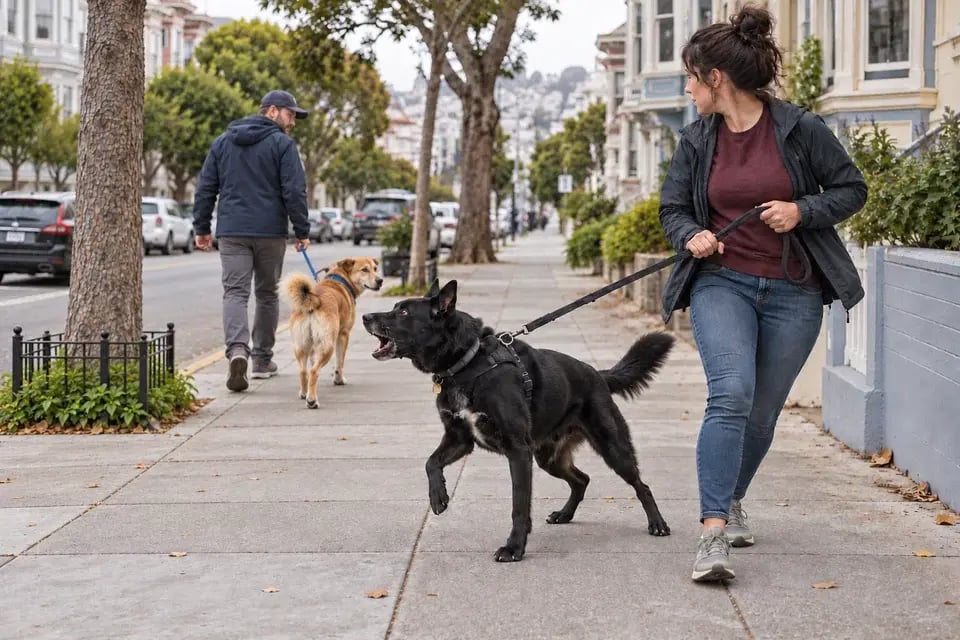
Is Koru K9 the right fit if my dog reacts on walks?
If you plan your walks around other dogs, tell us about the moment that’s hardest. Is it passing a dog on a narrow sidewalk in the Richmond, or stepping out of your building just as a neighbor comes in? That detail helps us decide what your dog needs to practice and whether a trainer-home stay is a good fit. In our San Francisco Board & Train program, your dog practices with their trainer first. Then we coach you through the same skills with your own leash in hand.
If your dog has snapped or bitten, we’ll ask what happened and discuss whether a trainer can safely care for them during a stay. If the hardest moment is specific to your building, such as getting past another dog in the lobby, we’ll also talk through whether it makes sense to start there together.
Tell us about your dog
What does leash reactivity look like for your dog?
A dog who lunges when another dog passes might be eager to greet them, frightened, or overwhelmed. The barking alone tells us very little. We want to hear what your dog saw, how close it was, and what happened once it passed. Maybe your dog can watch another dog at a distance on a walk in the Sunset and settle beside you, yet struggles when the same dog appears around a blind corner.
If your concern is aggression, the details of the incident matter. Growling when someone reaches for a chew, snapping at a visitor in the doorway, and turning to bite the hand holding the leash are different situations. Tell us who was nearby, what happened just beforehand, and whether anyone was hurt. You can talk us through it without asking your dog to repeat it. That conversation guides our aggression training assessment and helps us decide whether we can safely care for your dog in a trainer’s home.
Why we believe in training at the speed of the dog
Training starts at a safe distance where your dog can see another dog without reacting. We give them plenty of space from the beginning. Your dog might notice the other dog, turn back toward their trainer, and keep walking on a loose leash. Moments like these help your dog learn that the person holding the leash understands what they need and will keep them safe.
That’s why we’re careful about programs that promise a quick fix. Asking a frightened dog to face more than they can handle can make the fear worse. A dog who gets through one close pass quietly may still be scared. We pay attention to what happens afterward, too. Can they look away, let the tension out of their body, and settle back into the walk?
In the trainer’s home, we give your dog time to settle, learn the daily routine, and get to know the person caring for them. Once that relationship is in place, we teach skills somewhere quiet. When your dog can use those skills comfortably around another dog, we build on that success. We might walk a little farther together while keeping the same space between the dogs, or practice for a little longer at a distance your dog already handles well. We build distance and duration gradually, as your dog succeeds. At your go-home lesson, you practice reading those same signals so your dog learns they can count on you, too.
Those details are what we want you to hear in an update and recognize for yourself at go-home. “She noticed another dog up ahead, checked back in, and carried on walking” tells you what progress looks like and where to start on your next walk together.
Bringing those skills back to your San Francisco neighborhood
The walk that matters is the one you take together. When your trainer brings your dog home, you practice during a hands-on go-home lesson. If getting out of your building is the hardest part of the day, start there. Pick up the leash, approach the doorway together, and let your trainer coach you through the timing. You get to feel what works with your own dog.
Follow-up lessons and phone and email support give you a place to bring the questions that come up later. If most of the difficulty happens in one particular place, like a shared elevator or the entrance to your apartment, we can also talk through whether private in-home dog training makes more sense for your family.
Three questions to ask before you choose a Bay Area program
- “What would you do if another dog appeared around a corner?” Ask the trainer to describe how they’d handle a walk like yours, including what they’d change if your dog struggled.
- “How will I know my dog is making progress?” Ask for an example from an ordinary walk. Knowing your dog could walk calmly with another dog in view tells you more than hearing they had a good day.
- “Can you show me how to do this at my own front door?” Ask what you’ll practice with your dog before the trainer leaves and who you can call if the next walk is harder.
Your dog. Your questions.
Questions about Board & Train for leash reactivity and aggression
Does my dog have to greet other dogs to make progress?
No. A good first goal may be seeing another dog and continuing your walk together. We start with enough space for your dog to notice the other dog without reacting. As your dog succeeds, we gradually build how far you can walk together and how long they can stay comfortable.
Can my dog attend Board & Train if they’ve bitten before?
We review bite history before recommending a stay. Tell us what happened, who was involved, and whether anyone was injured. Those details help us decide whether a trainer can safely care for your dog in their home and which support makes sense for your family.
How long will it take for my dog to feel more comfortable on walks?
We can discuss a program length after learning about your dog. Feeling safe around another dog has its own timeline. In your updates, we’ll describe what your dog could handle that day, how much space they needed, and what they’re ready to practice next.
Should we choose Board & Train or in-home training?
If the hardest part of your walk is getting through your shared lobby, an in-home lesson lets us see that exact situation with you. A trainer-home stay can be a good fit for a dog who can settle away from home and would benefit from daily practice before you learn the skills together. We’ll talk through both options with you.
Will you show me what to do on our own San Francisco walks?
Yes. When your trainer brings your dog home, you take the leash and practice together. Bring up the moment you want help with, whether it’s leaving your building or spotting another dog up ahead. Follow-up lessons and phone and email support give you a place to bring questions after that first walk on your own.
Ready to get compliments on your well-behaved dog?
Tell us what a better walk would look like for you. Our Bay Area team will help you find the right next step for you and your dog.
Get Help for My Dog →